
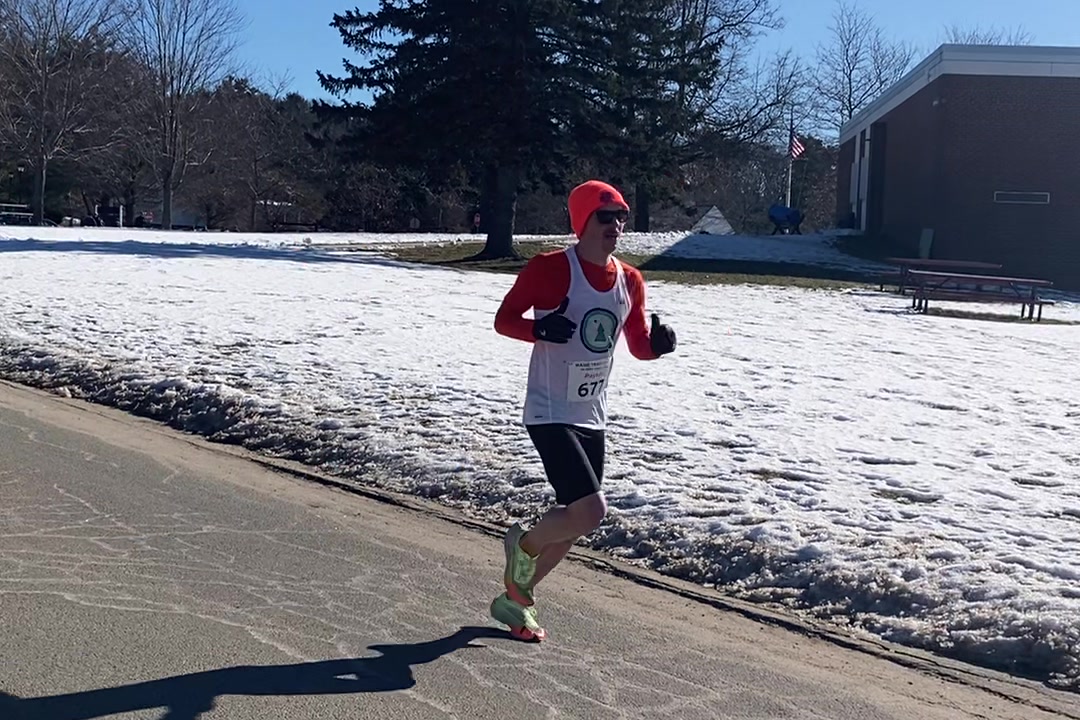
Somewhere around 40, a lot of runners notice the same thing. The workouts that used to work now leave you sore for four days. A calf tweak that used to last a week now lasts a month. And the race times start creeping in the wrong direction.
Here’s the good news: you’re not done getting better. Some of the toughest runners I know around Bangor are well past 40, including a guy who ran Boston in under three hours back in 2011 and is still finding ways to improve. But masters runners who keep improving almost always train a little differently than they did at 25.
I’ve coached runners from the mile to the marathon for more than ten years, and masters runners are a big part of who I work with. If this sounds like you, here’s what I’d adjust.
Step 1: Accept what actually changes (and what doesn’t)
A few things really do shift with age:
- Recovery takes longer. Hard days need more space around them.
- Power and muscle mass slowly decline if you don’t do anything about it.
- Your aerobic ceiling (VO2max) drifts down over time, but it’s still very trainable at any age.
What doesn’t change: consistency still wins. A runner who strings together months of steady training will beat their own “talented but on-and-off” self almost every time.
Step 2: Train by effort, not by your old paces
Chasing the splits you ran a decade ago is the fastest way to get hurt or burned out. Run by effort instead: breathing, feel, and heart rate if you use it.
- Easy days should feel truly easy. Conversational. Slower than your ego wants.
- Hard days are fewer, and smarter. Most of my masters athletes do one or two harder sessions a week, not three or four, and those sessions are controlled, not all-out.
Step 3: Run more often, but less hard
For most masters runners, I’d rather see five shorter runs than three long, hard ones. Frequency builds your aerobic engine and toughens up tendons and connective tissue a little at a time, without the big spikes in load that lead to injury.
For the quality work, I lean on sub-threshold training, the “Norwegian-style” approach. That means intervals at a comfortably hard effort, just below your threshold. We often start with very short intervals, like 200s and 400s at 10K to threshold pace with just 20–30 seconds of recovery. The short breaks keep you at a steady, controlled effort just under threshold the whole session. As the base builds, the reps get longer, like 4 x 6 minutes with a 1-minute jog, building toward 6 x 6. The effort stays comfortably hard, and you should finish feeling like you could have done one or two more. You get a lot of fitness for very little wear and tear, and with an easy day or two in between, you’re ready for the next session. That’s exactly what an older body needs.
I also keep one small dose of speed every other week, like 8–10 short hill reps of 10–20 seconds with full recovery, to hold on to power without the pounding of track intervals.
Step 4: Lift something. Seriously.
If you only add one thing this winter, make it strength training. Two short sessions a week (20–30 minutes) helps hold on to the muscle and power that fade with age, and it makes your tendons more resilient. Once you’ve learned the movements, make at least one session challenging: the last few reps of each set should feel hard. Do it on a hard running day, or the day after your long run, and keep it at least two days away from your fastest workout.
Keep it simple:
- Calf raises (bent-knee and straight-knee) for your Achilles and calves.
- Split squats, step-ups, or goblet squats for your legs. Add weight once the form is solid.
- Hip and core work, like bridges and planks.
- A little bounce: skipping, pogo hops, or low box jumps. Start small. Plyometrics help keep the “spring” in your stride, but they’re the part to ease into.
Step 5: Use the Maine winter to your advantage
December through February is the perfect masters window. November is still racing season, and some of the best fall running of the year. Once that wraps up, winter is your time. No races, no pressure, just time to build:
- Get consistent with 4–5 easy runs a week, adding a few relaxed strides or short hill sprints to one or two of them. Use the treadmill if the roads are glare ice.
- Add strength twice a week.
- Bring in sub-threshold work after 3–4 weeks of steady running. Start with one session a week, and add a second only if you’re recovering well.
Do that, and you head into spring ready to sharpen, not trying to get back in shape. In February, we switch into the build block for spring races. That’s also the perfect time to jump into the Mid-Winter Classic 10 Miler as a threshold fitness test. Your result there gives you fresh numbers to recalibrate your training zones for the build.
Step 6: Decide whether you want help
Coaching makes the biggest difference for masters runners who:
- keep getting hurt when they ramp up,
- notice that their old training plan doesn’t work anymore,
- have a specific goal, like a BQ in a new age group, or
- just want someone keeping the hard days hard and the easy days easy.
My coaching philosophy is process over outcome and health over speed. Consistency is what builds real, lasting speed, and we don’t need to sacrifice your body or the joy of running to get there. I’m a USATF Cross Country Coach and USATF Marathon Specialist, and I coach runners around Bangor with personalized plans through Training Peaks, weekly feedback, and race-day strategy.
Ready to build your spring? Let’s talk.
Spring Build 2027 runs from Monday, Jan. 18 to the Bangor Marathon on Sunday, June 6, 2027. It’s a small group with personalized plans, and masters runners are very welcome. Early-bird pricing ends Dec. 15.
Book a free intro call. We’ll talk about where you are, what you want from 2027, and whether we’d be a good fit. No pressure, and no spam.
📞 Call or text: 207-404-0338
✉️ Email: coaching@bangorareadistance.com
See you out there. For the long run.
Trent Packard, Bangor Area Distance
Leave a Reply